

The brightest take on this week’s science
There’s nothing like fresh science, hot off the press, to warm your December.
A new study from Australia investigates the role of coffee and tea in osteoporosis.
Plus, we take a look at recent research that suggests the roots of dementia begin in childhood.
Also in this issue:
🤯 Did you know not all frogs hatch as tadpoles?
🪐 A two-tailed planet like no other
🔬 A microscope mystery
Hot science, served fresh…
LOOK IN
The Roots of Dementia in Childhood

(Roger Wright/Getty Images)
Even before we are born, some risk factors for dementia may already be present.
Increasingly, evidence suggests that the roots of age-related cognitive decline could begin in early childhood.
One of the most important factors explaining cognitive ability at age 70, researchers say, is cognitive ability at age 11.
Later, in early adulthood, additional potential risk factors include:
Education
Head injuries
Physical activity
Social isolation
Growing up healthy could be key to growing old healthy.
HEADLINES
What Else We're Watching
🏅This week’s most read: Dick Van Dyke Credits His Longevity to One Habit, And It's Backed by Science
LOOK OUT
Coffee, Tea, and The Risk of Osteoporosis

(monkeybusinessimages/Getty Images)
Coffee and tea may have different consequences for the aging bones of women.
Osteoporosis causes weak and brittle bones in a third of women over the age of 50, and diet is thought to play a role in the steady loss of bone density.
In a new study, researchers analyzed the bones and beverage habits of roughly 9,700 women over 65 in Australia.
Those who regularly drank tea had higher bone mineral density in their hips than those who didn’t drink tea.
But those who regularly drank coffee showed mixed results.
Women who drank 5 or more cups of coffee per day tended to have lower bone mineral density scores.
Fewer cups seemed okay, at least in most cases. Women who drank alcohol relatively more seemed to be an exception, though…
ZOOM ZONE
Microscope Mystery: What Do You See?

(Craig P. Jewell/Getty Images)
A) Caffeine
B) Snowflake
C) Salt crystal
D) Amoeba
Answer at the bottom.
LOOK UP
A Two-Tailed Planet Like No Other

An illustration of exoplanet WASP-121b, also known as Tylos. (B. Gougeon/UdeM)
Roughly 880 light-years from Earth, there exists a two-tailed exoplanet like no other.
Its name is Tylos, and its long, hazy helium tails span nearly 60 percent of its orbit around its parent star.
Astronomers have seen exoplanets with leaky atmospheres before, but never one with two long extensions like this.
For 37 hours, experts watched Tylos’ tails chase each other around their star.
The findings are forcing scientists to completely re-evaluate our models for how exoplanets gradually lose their atmospheres.
WOW FACTOR
Science Fact of The Week

(Ivan Prates/Amphibian & Reptile Conservation)
Not all frogs enter the world as tadpoles. Some species hatch as froglets.
Boulanger's backpack frog (Cryptobatrachus boulengeri) is endemic to northern Colombia, and the female carries all her eggs on her back.
The sight of them hatching is very odd indeed. Trypophobics beware!
DOPAMINE HIT
Before You Go…
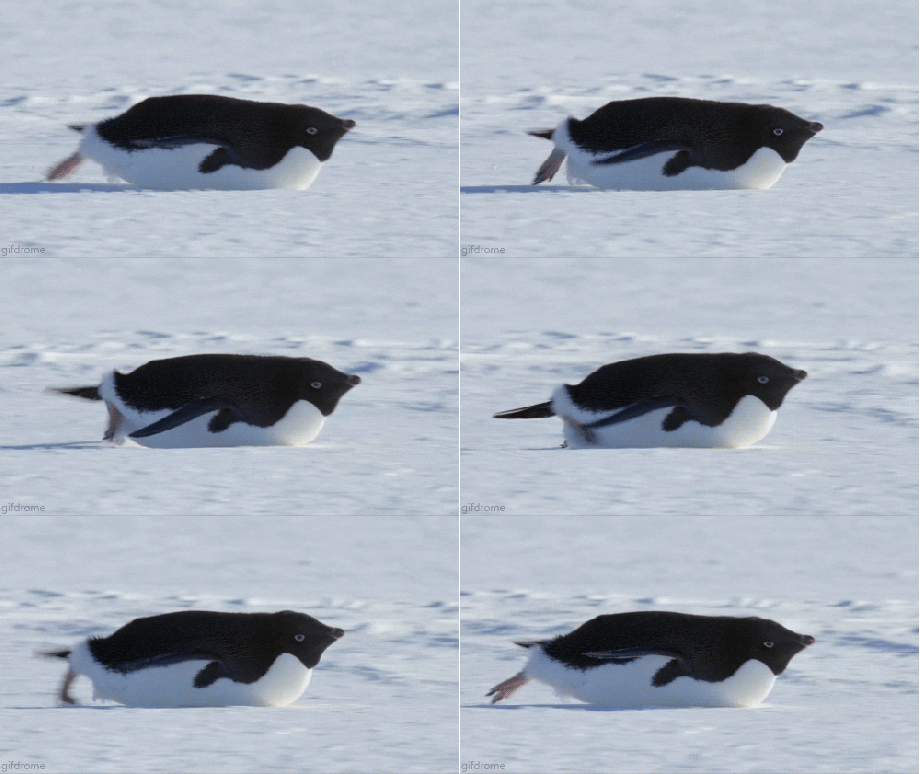
Keep pushing along! The end of the year is nearly here.
Microscope answer: Caffeine
Ever wondered how decaffeinated coffee works? Crystals of caffeine, like the one featured above, can be removed from coffee beans using a solvent called ethyl acetate, which is found in its natural form in many fruits.
That’s all for today… see you next week!
- Carly


