

The brightest take on this week’s science
Hello Spark readers!
This week, you’re getting an exclusive interview on the vast Roman road system we’ve barely begun to uncover – even after centuries of study.
Plus, you’ll learn about:
🧠 How music may impact your dementia risk
🧬 Why Neanderthals may not have gone extinct
🧪 What the world’s strongest acid can do
Onwards we scroll!
LOW-KEY GENIUS
Music May Reduce Dementia Risk

(Tatiana Maksimova/Getty Images)
Older people who listen to a lot of music have a lower risk of developing dementia, according to new research.
The study cannot prove cause and effect, but the findings join growing evidence that music may protect our brains.
Among 10,000 older Australians surveyed in the new research, those who ‘always’ listened to music, as opposed to ‘never’, ‘rarely’, or ‘sometimes’, were less likely to develop dementia after three years.
Thirty-nine percent less likely, to be exact.
This group also scored better on general cognition and memory tests.
Weirdly, though, playing a musical instrument didn’t show as strong an association…
HEADLINES
What Else We're Watching
🏅This week’s most read: Common Supplement Shows Concerning Link to Heart Failure
EXCLUSIVE INTERVIEW
Inside the Roman Empire’s Vast Road Network

An ancient Roman pedestrian crossing in Pompeii. (Gerard Puigmal/Getty Images)
A new, publicly available map of the Roman Empire’s road system is the most expansive to date, and yet it’s just the tip of the iceberg.
The confirmed roads could lap the Earth seven times, researchers estimate, yet 97 percent of the vast system remains unmapped.
Our head journalist, Michelle Starr, spoke to lead archaeologist Tom Brughmans of Aarhus University in Denmark about how little we have covered.
“This was a huge surprise and a sobering realization: Roads are one of the most enigmatic topics in Roman archaeology and history; they were all over the place,” says Brughmans.
“We have proverbs like, ‘All roads lead to Rome’.”
As it turns out, however, another city lies nearer the center of this extensive web…
Read the exclusive interview to find out which one.
ZOOM ZONE
Microscope Mystery: What Do You See?

(Connect Images/Gregory S. Paulson/Getty Images)
A) Spider silk
B) Dandelion seed
C) Sea urchin embryo
D) Cactus areole
Answer at the bottom.
LOOK OUT
Neanderthals May Not Have Truly Gone Extinct

Neanderthal skull discovered in 1908 in France. (Luna04/Wikimedia/CC BY-SA 3.0)
Neanderthals may never have truly gone extinct, according to new research.
In a way, the lineage is still hiding out – not in the wild, but in our very genes.
A new mathematical model has explored the possibility that Neanderthals gradually disappeared not through "true extinction" but through genetic absorption into the Homo sapiens species.
Interbreeding between the two lineages could have led to almost complete genetic dilution of Neanderthals within 10,000–30,000 years.
The findings suggest that our lengthy sexual affair may have brought about the demise of the Neanderthals.
Quite literally smothered by love.
WOW FACTOR
Science Fact of The Week
The strongest known superacid in the world – fluoroantimonic acid – is 100,000 times stronger than magic acid, which itself is 100 billion times more powerful than pure sulfuric acid (the strongest of the ‘normal’ acids).
Fluoroantimonic acid acts like it has a pH of -28. The only known material tough enough to contain it is Teflon and polymers with similar properties.
You can watch it eat through chicken flesh in this YouTube video from ChemicalForce:
DOPAMINE HIT
Before You Go…
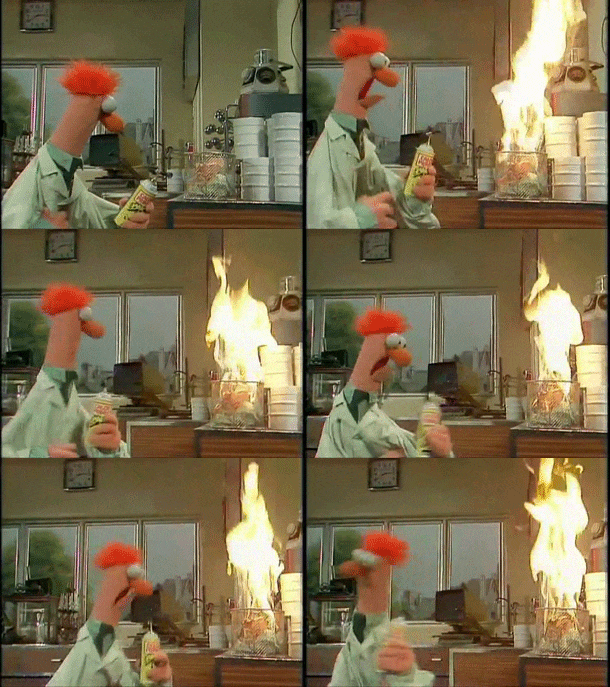
Safety first!
Microscope answer: Dandelion seed.
The fluffy white of a dandelion seed is 90 percent empty space, and yet it somehow generates an extraordinary vortex field - a swirling pocket of air, adjacent to, but separate from the dandelion’s body, that allows it to fly incredible distances: up to 100 kilometers.
That’s all for today… see you next week!
- Carly
P.S.
The countdown is on to see if you’re the winner of our Spark into Space sweepstakes and will be heading to Florida to train like an astronaut!
The winner will be randomly selected on December 11, but now we’re giving you a chance to boost your odds of winning!
Simply share this newsletter with your friends, and you’ll receive an extra entry for every friend that signs up.


